Introduction
The digitization of larger sectors encounters organizational, technical and legal problems. The potential applications of blockchain technology offer a unified solution in almost all sectors of the economy. However, due to the relative newness of this technology, there is still largely a lack of clarity as to how blockchain can be applied in a meaningful and conflict-free manner. This paper focuses on providing a broad overview of DLT and its potential when used correctly.
What is DLT?
Distributed Ledger Technology (DLT) is a decentralized digital transaction recording system that aims to establish consensus among decentralized databases. Decentralized means that the write permission does not lie with one instance, but is distributed over several instances. It allows all network participants to share write, read and save permissions. Transactions are verified and confirmed in a decentralized manner by network participants, eliminating the need for a third party to manage the account.
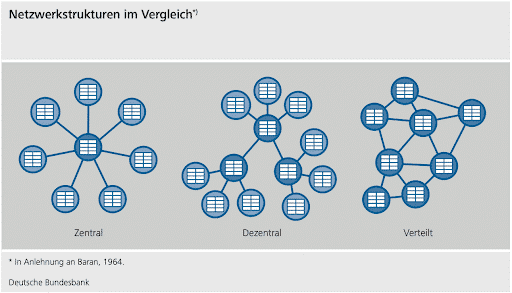
What is the difference between blockchain and DLT?
Blockchain is a subset of DLT. Blockchain describes a data structure that irrevocably stores the transaction history, whereas DLT additionally describes the data structure across multiple locations.
What are the advantages of DLT?
With its digital network structure and simultaneous access to a common database, DLT promises higher levels of transparency, operational efficiency, security and resilience, independence from intermediaries, and automation in settlement. DLT thus solves problems of conventional data backup systems. Its main advantages can be summarized as follows:
- The high transparency of DLT enables all network participants to view the entire data history of other network participants.
- Global financial inclusion allows any person to create a bank account using their smartphone, even if there are not yet any banks for citizens in the country of residence.
- Information can be tamper-proof stored.
- Transaction costs can be significantly reduced compared to conventional switching systems.
- The failure The loss of one site is compensated for by backup at other sites. compensated and offers a higher security of data storage an.
- The DLT enables network participants, transactions or information intermediary-free (P2P) exchange.
- Automated contract processing promises automated fulfillment of contractual claims through Smart Contract and thus high potential for process optimization.
What are the disadvantages of DLT?
In order to ensure the integrity and stability of the financial markets even under changing environmental conditions, requirements of the supervisory authorities, such as BaFin, must be complied with. Thus, the question still remains as to how requirements for IT security, data protection or consumer protection can be fully ensured when integrating blockchain systems. Only legally sound texts and the legal advice of a specialist lawyer can overcome the high legal hurdles in individual cases without conflict. The most common legal issues arise as follows:
- Multiple login without identification and without a clear name is possible. However, compliance with money laundering law requires clear identification of individuals and legal entities. This makes financial support for the financing of terrorist organizations or other criminal structures much more difficult.
- The complete transparency of all transactions and the irrevocability of the stored data may violate data protection directives of the EU if the personal data is available.
- Crypto-based assets are accessed via an access key (private key). Without it, there is no way to access assets.
Where does DLT find application?
The application of DLT is conceivable in almost all areas due to its efficiency. However, it is particularly interesting for financial sectors, logistics, open science, healthcare and public administration.
Conclusion:
DLT brings important new features that can create significant changes in the global world market. Provided that your functions are not fundamentally misused, some basic legal points such as data protection and security must nevertheless be observed. Anyone who has discovered the potential of DLT and wants to take advantage of the fruits of this technology for their company at an early stage should act in a legally secure manner. As a specialist in blockchain and corporate law, I will guide you as a lawyer and as a business consultant, guiding you past the big and small obstacles to efficiently achieve your vision.
Do you still have questions about the use and risk assessment of DLT? I will be happy to advise you. Arrange a free initial consultation right away. I look forward to hearing from you.