


• Latest
  • Trending
AI-generated music in films, games and on streaming platforms

AI-generated music in films, games and on streaming platforms

13. January 2026
BGH considers Uber Black to be anti-competitive

Distance learning, coaching and synchronous online formats

2. March 2026
Media outlets consider influencers law pointless

Manipulated QR codes and quishing

27. February 2026
AI agents as autonomous contractual partners?

AI agents as autonomous contractual partners?

26. February 2026
Platform cooperatives as a financing and business model

AI training data as an asset: accounting, IP strategy and exit factor

25. February 2026
Streaming setup, influencers and contract law

Influencers: when marketing suddenly becomes commercial agency law

18. February 2026
Insolvency administrator and access to tax office data?

NRW audits influencers – and suddenly normal rules apply?

12. February 2026
iStock 1405433207 scaled

Legal pitfalls in revenue-based financing for start-ups

12. February 2026
Streaming setup, influencers and contract law

Streaming setup, influencers and contract law

9. February 2026
Platform cooperatives as a financing and business model

Platform cooperatives as a financing and business model

8. February 2026
Frankfurt district court a.M. softens influencer jurisdiction

VAT on donations, gifts and “support” from influencers?

5. February 2026
Chamber Court on obligations to injuntture in the case of acts of third parties

Jurisdiction in the contract: one word too many, one word too few

4. February 2026
New info on the status of the State Media Treaty

Customer hotline and support in SaaS

2. February 2026
BGH considers Uber Black to be anti-competitive

BGH: FRAND objection fails due to lack of willingness to license

28. January 2026
marianregel

InformationCheck.de is live: side project for source-based classification of social media claims

22. January 2026
DPMA

Paid mods, fan guidelines and EULA: when monetization is possible

21. January 2026
Is an 8 year old allowed to be an Esport player?

LOI, term sheet, MoU, often binding for startups?

20. January 2026
What actually is an IP? In the games, music and film industry!

Freelancer paid, but still not getting rights?

19. January 2026
Affiliate links for streamers and influencers

Comparison sites as an SEO trick

16. January 2026
Reverse vesting

Vesting, good leavers, bad leavers – why a lack of regulations costs startups dearly

15. January 2026
ai generated g63ed67bf8 1280

AI guideline for agencies and external service providers

14. January 2026
  • Mehr als 3 Millionen Wörter Inhalt
  • |
  • info@itmedialaw.com
  • |
  • Tel: 03322 5078053
Kurzberatung
Rechtsanwalt Marian Härtel - ITMediaLaw

No products in the cart.

  • en English
  • de Deutsch
  • Informationen
    • Ideal partner
    • About lawyer Marian Härtel
    • Quick and flexible access
    • Principles as a lawyer
    • Why a lawyer and business consultant?
    • Focus areas of attorney Marian Härtel
      • Focus on start-ups
      • Investment advice
      • Corporate law
      • Cryptocurrencies, Blockchain and Games
      • AI and SaaS
      • Streamers and influencers
      • Games and esports law
      • IT/IP Law
      • Law firm for GMBH,UG, GbR
      • Law firm for IT/IP and media law
    • The everyday life of an IT lawyer
    • How can I help clients?
    • Testimonials
    • Team: Saskia Härtel – WHO AM I?
    • Agile and lean law firm
    • Price overview
    • Various information
      • Terms
      • Privacy policy
      • Imprint
  • Services
    • Support and advice of agencies
    • Contract review and preparation
    • Games law consulting
    • Consulting for influencers and streamers
    • Advice in e-commerce
    • DLT and Blockchain consulting
    • Legal advice in corporate law: from incorporation to structuring
    • Legal compliance and expert opinions
    • Outsourcing – for companies or law firms
    • Booking as speaker
  • News
    • Gloss / Opinion
    • Law on the Internet
    • Online retail
    • Law and computer games
    • Law and Esport
    • Blockchain and web law
    • Data protection Law
    • Copyright
    • Labour law
    • Competition law
    • Corporate
    • EU law
    • Law on the protection of minors
    • Tax
    • Other
    • Internally
  • Podcast
    • ITMediaLaw Podcast
  • Knowledge base
    • Laws
    • Legal terms
    • Contract types
    • Clause types
    • Forms of financing
    • Legal means
    • Authorities
    • Company forms
    • Tax
    • Concepts
  • Videos
    • Information videos – about Marian Härtel
    • Videos – about me (Couch)
    • Blogpost – individual videos
    • Videos on services
    • Shorts
    • Podcast format
    • Third-party videos
    • Other videos
  • Contact
  • Informationen
    • Ideal partner
    • About lawyer Marian Härtel
    • Quick and flexible access
    • Principles as a lawyer
    • Why a lawyer and business consultant?
    • Focus areas of attorney Marian Härtel
      • Focus on start-ups
      • Investment advice
      • Corporate law
      • Cryptocurrencies, Blockchain and Games
      • AI and SaaS
      • Streamers and influencers
      • Games and esports law
      • IT/IP Law
      • Law firm for GMBH,UG, GbR
      • Law firm for IT/IP and media law
    • The everyday life of an IT lawyer
    • How can I help clients?
    • Testimonials
    • Team: Saskia Härtel – WHO AM I?
    • Agile and lean law firm
    • Price overview
    • Various information
      • Terms
      • Privacy policy
      • Imprint
  • Services
    • Support and advice of agencies
    • Contract review and preparation
    • Games law consulting
    • Consulting for influencers and streamers
    • Advice in e-commerce
    • DLT and Blockchain consulting
    • Legal advice in corporate law: from incorporation to structuring
    • Legal compliance and expert opinions
    • Outsourcing – for companies or law firms
    • Booking as speaker
  • News
    • Gloss / Opinion
    • Law on the Internet
    • Online retail
    • Law and computer games
    • Law and Esport
    • Blockchain and web law
    • Data protection Law
    • Copyright
    • Labour law
    • Competition law
    • Corporate
    • EU law
    • Law on the protection of minors
    • Tax
    • Other
    • Internally
  • Podcast
    • ITMediaLaw Podcast
  • Knowledge base
    • Laws
    • Legal terms
    • Contract types
    • Clause types
    • Forms of financing
    • Legal means
    • Authorities
    • Company forms
    • Tax
    • Concepts
  • Videos
    • Information videos – about Marian Härtel
    • Videos – about me (Couch)
    • Blogpost – individual videos
    • Videos on services
    • Shorts
    • Podcast format
    • Third-party videos
    • Other videos
  • Contact
Rechtsanwalt Marian Härtel - ITMediaLaw

AI-generated music in films, games and on streaming platforms

13. January 2026
in Other
Reading Time: 6 mins read
0 0
A A
0
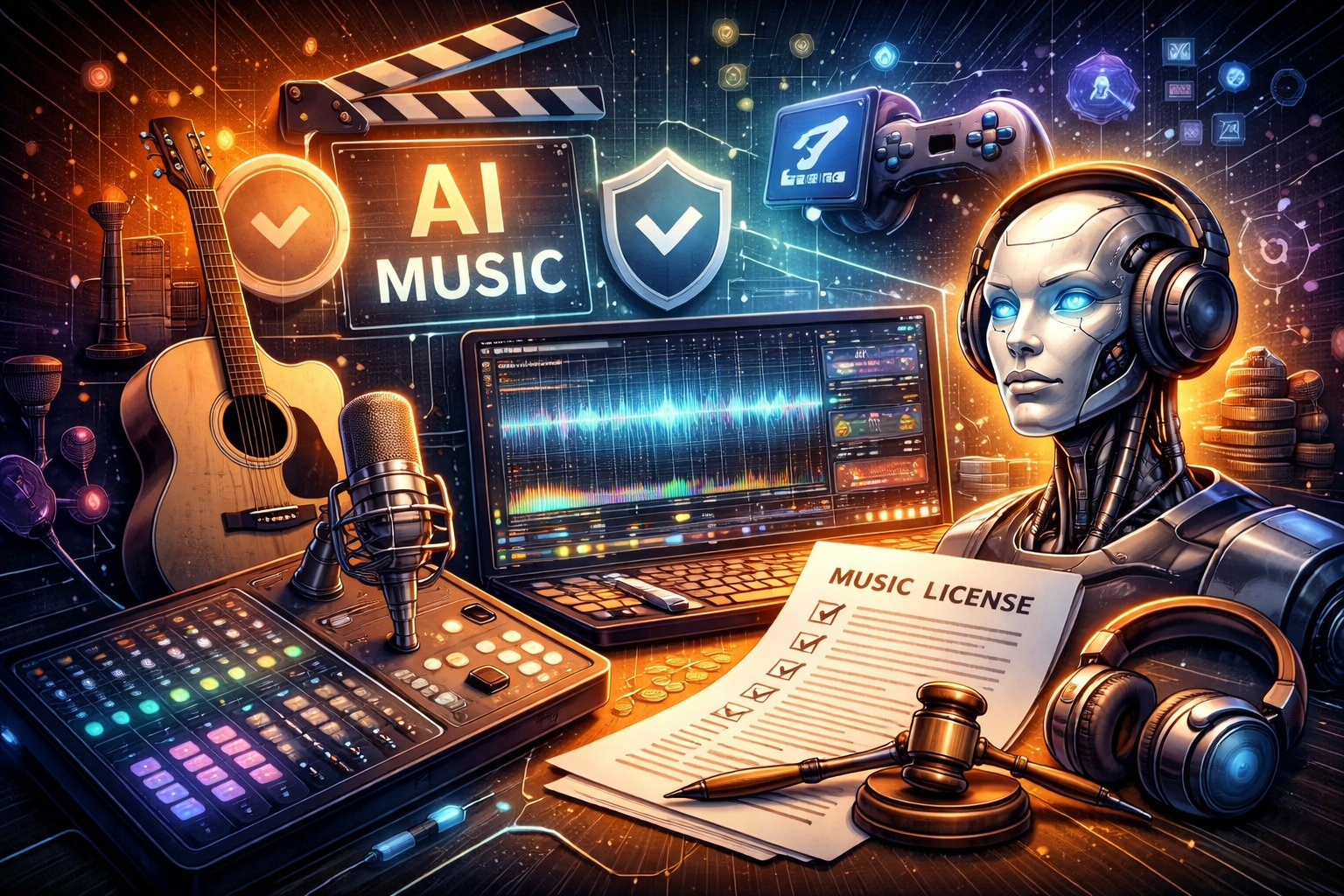
ChatGPT Image 13. Jan. 2026 12 35 04

AI-generated music is no longer an experiment in the professional media and games environment. Production companies, game studios, agencies and solo creators use AI tools to generate background music, loops, adaptive soundtracks or even complete songs. At the same time, uncertainty is growing: who actually owns these works? Can AI music be used commercially? What applies to platforms such as Spotify? And what contractual regulations are required when AI-based music is used in films, series, games or apps?

Content Hide
1. 1 Copyright situation: When is AI music even “a work”?
2. 2 AI music in films and series: License chains instead of composer contracts
3. 3 AI music in games and apps: adaptive scores, mods and monetization
4. 4. editing AI-based music: when is “original” music created?
5. 5. publication of AI songs on streaming platforms: Spotify, Suno & Co.
6. 6. contract drafting: What must be regulated in AI music contracts
7. 7 Outlook: AI regulation and market development
8. Conclusion: AI music is not a legal vacuum – but it can be controlled
8.1. Author: Marian Härtel

The legal assessment is more complex than many tool providers suggest. This is because AI music operates at the intersection of copyright law, contract law, platform rules and – increasingly – AI regulation. Anyone taking an unstructured approach here risks not only licensing problems, but also considerable economic uncertainties in terms of exploitation, monetization and re-licensing.

The following article classifies the most important constellations and shows how AI-generated music can be produced, edited, licensed and published in a legally compliant manner – with a special focus on contracts, rights chains and typical mistakes in practice.

1 Copyright situation: When is AI music even “a work”?

The central legal sticking point with AI-generated music is the question of whether a copyright-protected work is created at all. Under German and European copyright law, protection generally requires a personal intellectual creation. Music generated purely autonomously by an AI does not usually meet this criterion because there is no human author.

However, this does not mean that AI music is “free of rights”. Rather, the focus is shifting away from traditional copyright and towards contractual usage rights, ancillary copyrights, database and competition law and – in the platform context – terms of use and content policies.

The legally decisive factor is therefore not just how the music was created, but who is contractually granted which rights and how strong the human contribution is. As soon as a person specifically selects, structures, edits or combines the AI results, a copyright-relevant adaptation or collective work can be created. This threshold is fluid and highly dependent on the individual case – it cannot be replaced across the board by a tool marketing promise.

2 AI music in films and series: License chains instead of composer contracts

In the film and series sector, AI music is often used as a replacement or supplement to classic production music, for example for background scores, suspense areas or transitions. Legally, the question of “authorship” is less relevant than the clean license chain.

Production companies need legal certainty in three dimensions: Firstly, it must be clarified that the AI music used can be used commercially; secondly, it must be ruled out that third-party rights are infringed (in particular by training data); and thirdly, the rights of use must be transferable and sublicensable, for example to broadcasters, streaming platforms or international distribution partners.

Contracts should therefore not refer to “copyrights”, but to rights of use and exploitation of the AI output. Clear regulations on the use in terms of time, space and content, on editability and on transfer to third parties are key. An indemnification clause that covers the risk of the AI output infringing third-party rights is particularly important – even if this risk often remains with the producer.

A common mistake in practice is to treat AI music like classic stock music. Although many AI tools grant rights of use, they exclude certain forms of exploitation or reserve extensive rights of their own. Without explicit contractual clarification, this creates a gap that can become a real deal-breaker in the context of film financing, broadcaster acquisitions or international sales.

3 AI music in games and apps: adaptive scores, mods and monetization

AI music has a special dynamic in the games sector. Here, music is not only used in a linear fashion, but is often generated or adapted dynamically, for example depending on the course of the game, user behavior or in-game events. From a legal perspective, this places additional demands on contract design.

Game studios must ensure that they can not only “play” AI-generated music, but also change, combine, regenerate and permanently integrate it. Traditional licensing models fall short here. Instead, comprehensive rights to use, edit and integrate into interactive systems are required.

Then there is monetization. As soon as AI music becomes part of a paid game, an in-app purchase or a subscription, the requirements for legal certainty increase considerably. AI music can also become problematic in the modding environment if users contribute their own AI tracks and these are redistributed or monetized.

Contracts should therefore clearly regulate who is responsible for rights clearance, what content is permitted and how claims or takedown requests are handled. Without such regulations, AI music can quickly become a liability risk – especially in the event of platform infringements or complaints from rights holders.

4. editing AI-based music: when is “original” music created?

A key practical issue is the question of whether and when the editing of AI music gives rise to separate rights. Many creatives assume that any reworking automatically constitutes a separate work. This is not legally tenable.

The decisive factor is the level of creativity of the adaptation. Pure technical adjustments – such as volume, tempo or format – are not sufficient. A copyright-protected work can only be created if the selection, arrangement, combination with other elements or targeted creative interventions add their own intellectual contribution.

For contracts, this means that anyone who edits AI music should not rely on a supposed “new authorship”, but should clarify the rights to the source material properly. Otherwise, even an elaborately edited track may not be legally usable because the usage rights to the original AI output are missing or restricted.

Especially in the agency and studio environment, a clear separation between tool rights, editing rights and exploitation rights is therefore necessary. Only if all three levels are clearly regulated can a reliable rights position be created.

5. publication of AI songs on streaming platforms: Spotify, Suno & Co.

The question of whether and how AI-generated songs can be published on streaming platforms is currently of particular practical relevance. Tools such as Suno or similar services make it possible to generate complete songs including vocals. The temptation to publish this content directly on platforms such as Spotify is great.

Legally, there are several levels to consider here. First of all, it must be checked whether the terms of use of the AI tool permit such publication at all. Many providers differentiate between private use, commercial use and reuse via third-party platforms. It is not uncommon for streaming releases to only be permitted in certain tariff models or not at all.

In addition, there are Spotify’s platform rules. Spotify requires that uploaders have all the necessary rights and do not infringe the rights of third parties. In recent years, Spotify has also increasingly taken action against content that is classified as problematic, misleading or automated on a massive scale. AI music is not taboo here, but is increasingly being scrutinized.

The handling of voices and style imitations is particularly sensitive. AI songs that are recognizably based on real artists or imitate their voices pose considerable risks – regardless of whether the AI tool technically allows this. There is not only the threat of copyright claims, but also claims under personality rights and competition law.

Anyone wishing to publish AI songs should therefore ensure that (1) the tool license permits publication, (2) no identifiable third-party rights are infringed, (3) the metadata is correct and there is no deception about authorship or contributors, and (4) the content complies with the platform guidelines. Failure to do so may result in blocking, loss of revenue or even account measures.

6. contract drafting: What must be regulated in AI music contracts

From a legal perspective, AI music is not a special case, but a contractual problem. It is crucial that contracts do not pretend to deal with classical compositions. Instead, they must reflect the special features of AI output.

Clear regulations on the rights of use of the AI output, commercial usability, processing and relicensing are absolutely essential. Equally important are assurances of freedom from rights and regulations on liability, particularly in the event of third-party claims or platform measures.

In practice, it is a good idea to explicitly treat AI music as a license-based means of production. This creates clarity for clients, platforms and exploiters and avoids later discussions about authorship or protectability.

7 Outlook: AI regulation and market development

In view of the EU AI Act and the increasing regulation of AI systems, the music sector will also come under greater scrutiny. Although AI music tools are not generally high-risk systems at present, transparency and governance obligations will increase. For professional producers, this means that those who create clean structures today will have a clear advantage tomorrow.

At the same time, it is foreseeable that platforms will continue to tighten their rules. AI music will not disappear, but it will be more curated, labeled and reviewed. Legal certainty will therefore become a real competitive factor.

Conclusion: AI music is not a legal vacuum – but it can be controlled

AI-generated music opens up enormous creative and commercial opportunities, particularly in film, games and digital media. At the same time, it is more legally demanding than many people assume. If you want to use or publish AI music professionally, there is no getting around clean contract drafting, a clear chain of rights and knowledge of the platform rules.

The crucial point is not whether AI is the “author”, but whether the exploitation is legally protected. This is precisely where it is decided whether AI music becomes a scalable business model or a latent liability risk.

Marian Härtel
Author: Marian Härtel

Marian Härtel ist Rechtsanwalt und Fachanwalt für IT-Recht mit einer über 25-jährigen Erfahrung als Unternehmer und Berater in den Bereichen Games, E-Sport, Blockchain, SaaS und Künstliche Intelligenz. Seine Beratungsschwerpunkte umfassen neben dem IT-Recht insbesondere das Urheberrecht, Medienrecht sowie Wettbewerbsrecht. Er betreut schwerpunktmäßig Start-ups, Agenturen und Influencer, die er in strategischen Fragen, komplexen Vertragsangelegenheiten sowie bei Investitionsprojekten begleitet. Dabei zeichnet sich seine Beratung durch einen interdisziplinären Ansatz aus, der juristische Expertise und langjährige unternehmerische Erfahrung miteinander verbindet. Ziel seiner Tätigkeit ist stets, Mandanten praxisorientierte Lösungen anzubieten und rechtlich fundierte Unterstützung bei der Umsetzung innovativer Geschäftsmodelle zu gewährleisten.

Weitere spannende Blogposts

The Digital Services Act and its impact on the games industry

The Digital Services Act and its impact on the games industry
22. June 2023

The Digital Services Act (DSA) represents a significant change in the European digital regulatory framework and has a strong impact...

Read moreDetails
When is the contract concluded in the online store or with SaaS services

2b14342543cc4e965f96a23212cffb88
26. June 2024

The time of the conclusion of the contract in online stores and for SaaS services is for providers of largehe...

Read moreDetails

Twitch streamers and changes to the Interstate Broadcasting Treaty

judge plays videogames in his spare time
7. November 2022

Due to some inquiries from today about "yellow letters" for streamers on Twitch, I would like to refer to my...

Read moreDetails
Understanding the cease-and-desist declaration: important insights from the BGH ruling of January 12, 2023

BGH considers Uber Black to be anti-competitive
19. May 2023

What was it about? In the world of competition law, the cease and desist letter is a key tool for...

Read moreDetails

Legal risks associated with long development times and discontinuation of crowd-funded games

Legal risks associated with long development times and discontinuation of crowd-funded games
11. April 2025

Crowdfunding has established itself as a financing model in the games industry. Developers collect money from supporters to pre-finance the...

Read moreDetails

BGH to decide on Yelp reviews in January

No more free tissues at the pharmacy?
20. November 2019

Facts The applicant claims that Yelp is injunctive relief, determination and damages for its assessment representations. As many will know,...

Read moreDetails

Is the Free2Play distribution model anti-competitive?

Is the Free2Play distribution model anti-competitive?
23. October 2018

In a case I am representing, the question currently arises, in addition to numerous other problems, as to whether the...

Read moreDetails

Pictograms can be copyrighted

copyright
24. June 2019

In a recent ruling, the Frankenthal District Court stated that pictograms can also be protected by copyright and therefore cannot...

Read moreDetails

Hundreds of thousands of “parking tickets” illegal?

Hundreds of thousands of “parking tickets” illegal?
7. November 2022

In a landmark decision, the Higher Regional Court of Frankfurt am Main (OLG) has declared the monitoring of stationary traffic...

Read moreDetails
BGH considers Uber Black to be anti-competitive
Law and Esport

Distance learning, coaching and synchronous online formats

2. March 2026

The Distance Learning Protection Act (FernUSG) has been experiencing a renaissance for some time now. What for decades was considered...

Read moreDetails

Media outlets consider influencers law pointless

Manipulated QR codes and quishing

27. February 2026
AI agents as autonomous contractual partners?

AI agents as autonomous contractual partners?

26. February 2026
Platform cooperatives as a financing and business model

AI training data as an asset: accounting, IP strategy and exit factor

25. February 2026
Streaming setup, influencers and contract law

Influencers: when marketing suddenly becomes commercial agency law

18. February 2026

Podcastfolge

43a60cb39d7ea477ac8f3845c1b7739c

Legal advice for start-ups – investments that pay off

8. December 2024

This episode of the ITmedialaw.com podcast is all about the importance of legal advice for startups. Host Marian Härtel talks...

Read moreDetails

8315f1ef298eb54dfeed2f5e55c8b9da 1

First test episode of the ITMediaLaw Podcast

26. August 2024
8ffe8f2a4228de20d20238899b3d922e

Web3, blockchain and law – a critical review

26. September 2024
Looking to the future: How technology is changing the law

Looking to the future: How technology is changing the law

18. February 2025
052c2ca5ca0421f0316b42073ce61791

Innovative business models – risk and opportunity at the same time

10. September 2024

Video

My transparent billing

My transparent billing

10. February 2025

In this video, I talk a bit about transparent billing and how I communicate what it costs to work with...

Read moreDetails


Fascination between law and technology

Fascination between law and technology

10. February 2025
My two biggest challenges are?

My two biggest challenges are?

10. February 2025
What really makes me happy

What really makes me happy

10. February 2025
What I love about my job!

What I love about my job!

10. February 2025
  • Privacy policy
  • Imprint
  • Contact
  • About lawyer Marian Härtel
Marian Härtel, Rathenaustr. 58a, 14612 Falkensee, info@itmedialaw.com

Marian Härtel - Rechtsanwalt für IT-Recht, Medienrecht und Startups, mit einem Fokus auf innovative Geschäftsmodelle, Games, KI und Finanzierungsberatung.

Welcome Back!

Login to your account below

Forgotten Password? Sign Up

Create New Account!

Fill the forms below to register

All fields are required. Log In

Retrieve your password

Please enter your username or email address to reset your password.

Log In
  • Informationen
    • Ideal partner
    • About lawyer Marian Härtel
    • Quick and flexible access
    • Principles as a lawyer
    • Why a lawyer and business consultant?
    • Focus areas of attorney Marian Härtel
      • Focus on start-ups
      • Investment advice
      • Corporate law
      • Cryptocurrencies, Blockchain and Games
      • AI and SaaS
      • Streamers and influencers
      • Games and esports law
      • IT/IP Law
      • Law firm for GMBH,UG, GbR
      • Law firm for IT/IP and media law
    • The everyday life of an IT lawyer
    • How can I help clients?
    • Testimonials
    • Team: Saskia Härtel – WHO AM I?
    • Agile and lean law firm
    • Price overview
    • Various information
      • Terms
      • Privacy policy
      • Imprint
  • Services
    • Support and advice of agencies
    • Contract review and preparation
    • Games law consulting
    • Consulting for influencers and streamers
    • Advice in e-commerce
    • DLT and Blockchain consulting
    • Legal advice in corporate law: from incorporation to structuring
    • Legal compliance and expert opinions
    • Outsourcing – for companies or law firms
    • Booking as speaker
  • News
    • Gloss / Opinion
    • Law on the Internet
    • Online retail
    • Law and computer games
    • Law and Esport
    • Blockchain and web law
    • Data protection Law
    • Copyright
    • Labour law
    • Competition law
    • Corporate
    • EU law
    • Law on the protection of minors
    • Tax
    • Other
    • Internally
  • Podcast
    • ITMediaLaw Podcast
  • Knowledge base
    • Laws
    • Legal terms
    • Contract types
    • Clause types
    • Forms of financing
    • Legal means
    • Authorities
    • Company forms
    • Tax
    • Concepts
  • Videos
    • Information videos – about Marian Härtel
    • Videos – about me (Couch)
    • Blogpost – individual videos
    • Videos on services
    • Shorts
    • Podcast format
    • Third-party videos
    • Other videos
  • Contact
  • en English
  • de Deutsch
Kostenlose Kurzberatung