
• Latest
  • Trending
End of anonymity on review platforms like Kununu?

Semi-fungible tokens (SFTs) in the context of the GDPR

10. April 2024
BGH considers Uber Black to be anti-competitive

Distance learning, coaching and synchronous online formats

2. March 2026
Media outlets consider influencers law pointless

Manipulated QR codes and quishing

27. February 2026
AI agents as autonomous contractual partners?

AI agents as autonomous contractual partners?

26. February 2026
Platform cooperatives as a financing and business model

AI training data as an asset: accounting, IP strategy and exit factor

25. February 2026
Streaming setup, influencers and contract law

Influencers: when marketing suddenly becomes commercial agency law

18. February 2026
Insolvency administrator and access to tax office data?

NRW audits influencers – and suddenly normal rules apply?

12. February 2026
iStock 1405433207 scaled

Legal pitfalls in revenue-based financing for start-ups

12. February 2026
Streaming setup, influencers and contract law

Streaming setup, influencers and contract law

9. February 2026
Platform cooperatives as a financing and business model

Platform cooperatives as a financing and business model

8. February 2026
Frankfurt district court a.M. softens influencer jurisdiction

VAT on donations, gifts and “support” from influencers?

5. February 2026
Chamber Court on obligations to injuntture in the case of acts of third parties

Jurisdiction in the contract: one word too many, one word too few

4. February 2026
New info on the status of the State Media Treaty

Customer hotline and support in SaaS

2. February 2026
BGH considers Uber Black to be anti-competitive

BGH: FRAND objection fails due to lack of willingness to license

28. January 2026
marianregel

InformationCheck.de is live: side project for source-based classification of social media claims

22. January 2026
DPMA

Paid mods, fan guidelines and EULA: when monetization is possible

21. January 2026
Is an 8 year old allowed to be an Esport player?

LOI, term sheet, MoU, often binding for startups?

20. January 2026
What actually is an IP? In the games, music and film industry!

Freelancer paid, but still not getting rights?

19. January 2026
Affiliate links for streamers and influencers

Comparison sites as an SEO trick

16. January 2026
Reverse vesting

Vesting, good leavers, bad leavers – why a lack of regulations costs startups dearly

15. January 2026
ai generated g63ed67bf8 1280

AI guideline for agencies and external service providers

14. January 2026
  • Mehr als 3 Millionen Wörter Inhalt
  • |
  • info@itmedialaw.com
  • |
  • Tel: 03322 5078053
Kurzberatung
Rechtsanwalt Marian Härtel - ITMediaLaw

No products in the cart.

  • en English
  • de Deutsch
  • Informationen
    • Ideal partner
    • About lawyer Marian Härtel
    • Quick and flexible access
    • Principles as a lawyer
    • Why a lawyer and business consultant?
    • Focus areas of attorney Marian Härtel
      • Focus on start-ups
      • Investment advice
      • Corporate law
      • Cryptocurrencies, Blockchain and Games
      • AI and SaaS
      • Streamers and influencers
      • Games and esports law
      • IT/IP Law
      • Law firm for GMBH,UG, GbR
      • Law firm for IT/IP and media law
    • The everyday life of an IT lawyer
    • How can I help clients?
    • Testimonials
    • Team: Saskia Härtel – WHO AM I?
    • Agile and lean law firm
    • Price overview
    • Various information
      • Terms
      • Privacy policy
      • Imprint
  • Services
    • Support and advice of agencies
    • Contract review and preparation
    • Games law consulting
    • Consulting for influencers and streamers
    • Advice in e-commerce
    • DLT and Blockchain consulting
    • Legal advice in corporate law: from incorporation to structuring
    • Legal compliance and expert opinions
    • Outsourcing – for companies or law firms
    • Booking as speaker
  • News
    • Gloss / Opinion
    • Law on the Internet
    • Online retail
    • Law and computer games
    • Law and Esport
    • Blockchain and web law
    • Data protection Law
    • Copyright
    • Labour law
    • Competition law
    • Corporate
    • EU law
    • Law on the protection of minors
    • Tax
    • Other
    • Internally
  • Podcast
    • ITMediaLaw Podcast
  • Knowledge base
    • Laws
    • Legal terms
    • Contract types
    • Clause types
    • Forms of financing
    • Legal means
    • Authorities
    • Company forms
    • Tax
    • Concepts
  • Videos
    • Information videos – about Marian Härtel
    • Videos – about me (Couch)
    • Blogpost – individual videos
    • Videos on services
    • Shorts
    • Podcast format
    • Third-party videos
    • Other videos
  • Contact
  • Informationen
    • Ideal partner
    • About lawyer Marian Härtel
    • Quick and flexible access
    • Principles as a lawyer
    • Why a lawyer and business consultant?
    • Focus areas of attorney Marian Härtel
      • Focus on start-ups
      • Investment advice
      • Corporate law
      • Cryptocurrencies, Blockchain and Games
      • AI and SaaS
      • Streamers and influencers
      • Games and esports law
      • IT/IP Law
      • Law firm for GMBH,UG, GbR
      • Law firm for IT/IP and media law
    • The everyday life of an IT lawyer
    • How can I help clients?
    • Testimonials
    • Team: Saskia Härtel – WHO AM I?
    • Agile and lean law firm
    • Price overview
    • Various information
      • Terms
      • Privacy policy
      • Imprint
  • Services
    • Support and advice of agencies
    • Contract review and preparation
    • Games law consulting
    • Consulting for influencers and streamers
    • Advice in e-commerce
    • DLT and Blockchain consulting
    • Legal advice in corporate law: from incorporation to structuring
    • Legal compliance and expert opinions
    • Outsourcing – for companies or law firms
    • Booking as speaker
  • News
    • Gloss / Opinion
    • Law on the Internet
    • Online retail
    • Law and computer games
    • Law and Esport
    • Blockchain and web law
    • Data protection Law
    • Copyright
    • Labour law
    • Competition law
    • Corporate
    • EU law
    • Law on the protection of minors
    • Tax
    • Other
    • Internally
  • Podcast
    • ITMediaLaw Podcast
  • Knowledge base
    • Laws
    • Legal terms
    • Contract types
    • Clause types
    • Forms of financing
    • Legal means
    • Authorities
    • Company forms
    • Tax
    • Concepts
  • Videos
    • Information videos – about Marian Härtel
    • Videos – about me (Couch)
    • Blogpost – individual videos
    • Videos on services
    • Shorts
    • Podcast format
    • Third-party videos
    • Other videos
  • Contact
Rechtsanwalt Marian Härtel - ITMediaLaw

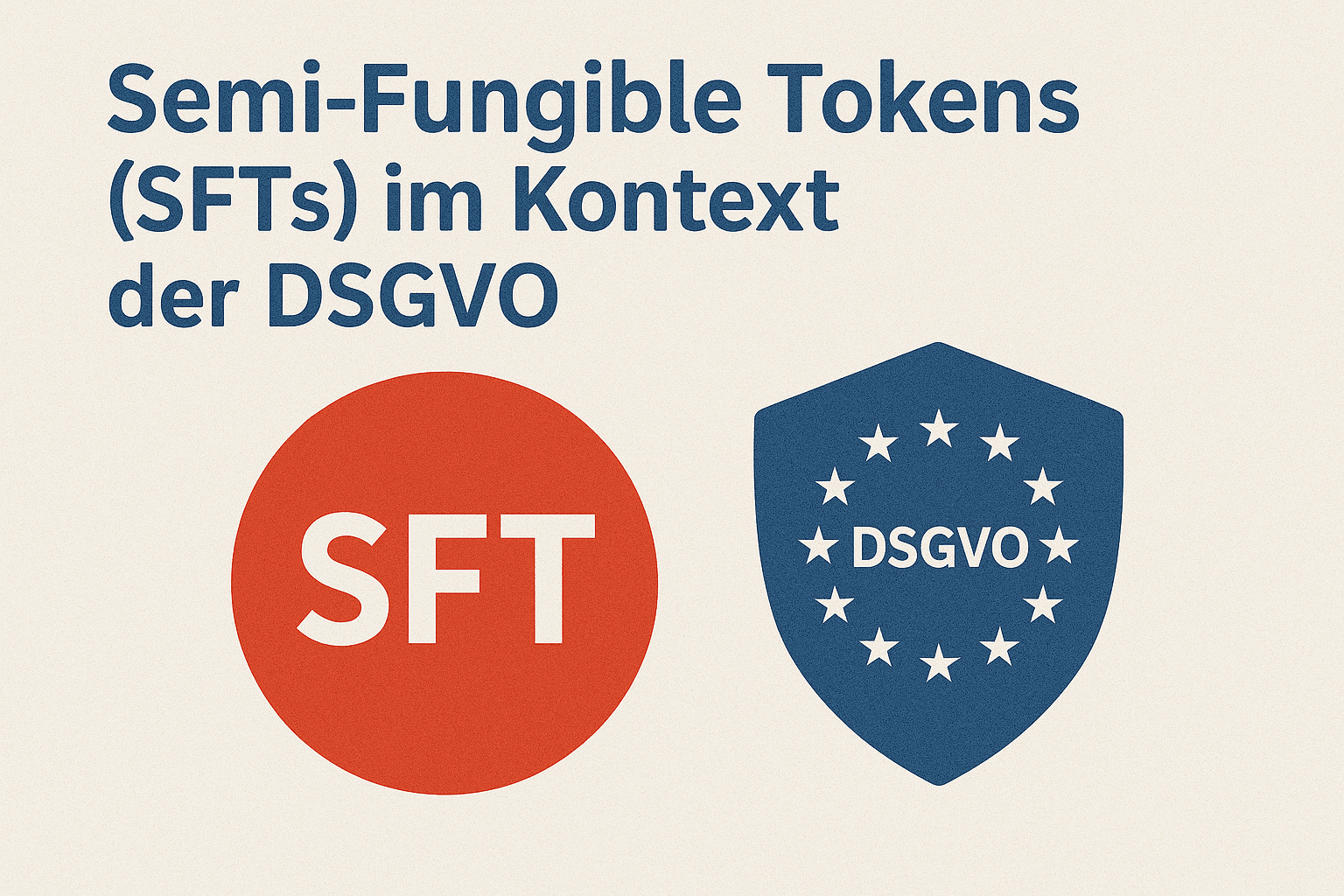
Semi-fungible tokens (SFTs) in the context of the GDPR

10. April 2024
in Blockchain and web law
Reading Time: 4 mins read
0 0
A A
0
ChatGPT Image 25. Apr. 2025 09 15 44

A legal consideration

Key Facts
  • Data minimization: The GDPR requires personal data to be stored only for as long as necessary; blockchain contradicts this principle.
  • Right to be forgotten: Users can request data erasure, but permanent blockchain storage makes this difficult to implement.
  • Accountability: Decentralized blockchain structures make it difficult to identify responsible parties, which is necessary for GDPR compliance.
  • SFTs offer potential: semi-fungible tokens could develop innovative solutions for GDPR compliance
  • Off-chain solutions: Storing personal data outside the blockchain could better fulfill GDPR requirements
  • Interdisciplinary cooperation: Cooperation between lawyers, technicians and data protection experts is essential for innovative solutions.
  • Setting new standards: Challenges posed by SFTs offer opportunities for progress in data protection in the digital world.

The introduction of semi-fungible tokens (SFTs) has not only opened up new avenues in blockchain technology, but also poses new challenges for lawyers and data protection experts. These developments are particularly relevant to my advisory work, in which I advise clients on the legal aspects of blockchain technology, including the GDPR. SFTs give rise to complex legal issues that are important for both technology companies and consumers. In my practice, I often encounter the need to develop innovative solutions that reconcile technological progress with the strict requirements of the GDPR.

This article aims to shed light on the specific legal issues arising from the use of SFTs in connection with the GDPR. In particular, the fundamental conflict between the GDPR and blockchain systems will be examined. In my experience as a lawyer, it is essential to understand the technical characteristics of SFTs in detail and to evaluate them in the context of the current legal situation. A deep understanding of how SFTs work and how they are embedded in blockchain technology is essential in order to provide effective and legally secure advice.

By combining my legal expertise with practical experience in blockchain technologies, I strive to help clients overcome the legal challenges posed by SFTs while ensuring compliance with the GDPR. This work requires constant engagement with the latest developments in the blockchain world and flexible adaptation of legal advice to these dynamic changes.

Fundamental conflict: GDPR vs. blockchain

The GDPR and blockchain technology are in a fundamental conflict due to their different basic principles. On the one hand, the GDPR aims to strengthen the protection of personal data and give individuals more control over their data. This includes the right to be forgotten, data minimization and the need to erase data. On the other hand, blockchain systems are based on a decentralized and unchangeable structure in which data can no longer be changed or removed once it has been entered. This characteristic is in direct contradiction to some of the core requirements of the GDPR.

The role of SFTs in this context

Semi-fungible tokens (SFTs) combine the features of fungible and non-fungible tokens and thus offer greater flexibility in the handling of data. Thanks to their unique ability to change states, they can adapt to different requirements. For example, SFTs can start out as exchangeable assets, similar to traditional cryptocurrencies, and under certain circumstances transform into unique, non-exchangeable assets.

This flexibility opens up a wide range of possible applications. In the gaming industry, for example, SFTs can be used both as in-game currency and as unique collectibles or rewards. In this context, they start as general game currency and can turn into rare items that have a specific value within the game. Another application example can be found in the area of digital tickets. SFTs can be used as normal admission tickets which, after attending an event, are transformed into unique collector’s items that serve as souvenirs of the event.

However, despite their adaptability and variety of applications, SFTs must take the requirements of the GDPR into account. The main question here is how the principles of immutability of blockchain data can be reconciled with the GDPR requirements, such as the right to be forgotten and data minimization. Innovative solutions need to be found that strike a balance between the technological functionality of SFTs and data protection requirements.

Data protection challenges for SFTs

  • Data minimization and storage limitation: The GDPR requires that personal data is only stored to the extent and for as long as it is necessary for the original purpose. Permanent storage in a blockchain contradicts this principle.
  • Right to be forgotten: This right allows individuals to request the erasure of their personal data. However, data is permanently stored in a blockchain, which makes the implementation of this right more difficult.
  • Accountability and liability: The decentralized nature of blockchain systems makes it difficult to identify a clearly defined controller for data processing, which is necessary for GDPR compliance.

Solutions and future prospects

Despite the challenges associated with their integration, semi-fungible tokens (SFTs) offer significant potential for the development of mechanisms that could enable improved compliance with the General Data Protection Regulation (GDPR). One possibility is the development of technologies or processes that allow the anonymization or pseudo-anonymization of personal data within a blockchain. This would mean that the identity of the data subjects remains protected, while their data can continue to be used within the blockchain technology.

In addition, the use of off-chain databases in conjunction with SFTs could be another way to improve GDPR compliance. In this model, personal data would be stored outside the blockchain, while only non-personal or highly anonymized data would be stored on the blockchain itself. This separation could help to harmonize the immutability of the blockchain with the data protection requirements of the GDPR.

SFTs could be particularly interesting for game providers, collector portals or companies that want to use blockchain technology. Their ability to switch between interchangeable and unique states offers flexible application possibilities. In the gaming sector, for example, SFTs could be used both as in-game currency and as rare, unique items. For collector portals, they offer the opportunity to initially offer objects as interchangeable goods that later become unique collector’s items.

These potential applications highlight the importance of ensuring that the development of SFTs and their application in different industries is accompanied by an in-depth knowledge of both the technical and legal aspects. The integration of SFTs into existing legal structures requires continuous adjustments to ensure that both the technological advantages are utilized and the legal requirements are met.

To achieve such a balance, close cooperation between technology experts, lawyers and data protection officers is essential. This interdisciplinary collaboration makes it possible to develop innovative solutions that both utilize the uniqueness of SFTs and meet the strict data protection requirements of the GDPR. Only through this integrative approach can the full benefits of SFTs be realized while at the same time safeguarding the data protection needs of users.

Conclusion

SFTs are an interesting development in blockchain technology, but raise complex legal issues, particularly with regard to the GDPR. Solving these issues requires innovative approaches and close coordination between technological development and data protection law. In this new legal territory lies the opportunity to set new standards for data protection in the digital world.

Marian Härtel
Author: Marian Härtel

Marian Härtel ist Rechtsanwalt und Fachanwalt für IT-Recht mit einer über 25-jährigen Erfahrung als Unternehmer und Berater in den Bereichen Games, E-Sport, Blockchain, SaaS und Künstliche Intelligenz. Seine Beratungsschwerpunkte umfassen neben dem IT-Recht insbesondere das Urheberrecht, Medienrecht sowie Wettbewerbsrecht. Er betreut schwerpunktmäßig Start-ups, Agenturen und Influencer, die er in strategischen Fragen, komplexen Vertragsangelegenheiten sowie bei Investitionsprojekten begleitet. Dabei zeichnet sich seine Beratung durch einen interdisziplinären Ansatz aus, der juristische Expertise und langjährige unternehmerische Erfahrung miteinander verbindet. Ziel seiner Tätigkeit ist stets, Mandanten praxisorientierte Lösungen anzubieten und rechtlich fundierte Unterstützung bei der Umsetzung innovativer Geschäftsmodelle zu gewährleisten.

Tags: BeratungBlockchainConsumerCustomizationData protection LawDevelopmentGamingGDPRGeneral Data Protection RegulationHaftungLegal issuesPersonal dataPrivacyrightTechnology

Weitere spannende Blogposts

Fees on SEPA transfers for old contracts inadmissible

Fees on SEPA transfers for old contracts inadmissible
29. October 2019

In a case brought by the VZBV against Vodafone, the Munich Regional Court ruled that the ban on fees for...

Read moreDetails

Decided: No more broadcasting licences for streamers in the new media state treaty!

fotolia 8894218 xs trans 3
5. December 2019

There is very good news for streamers today. The Media State Treaty was finally adopted, which is expected to enter...

Read moreDetails

File sharing warning: How to react correctly

f9d66e8b2bf7022d8591e13d3d0e83fe
10. July 2024

Have you received a warning about file sharing from law firms such as Frommer Legal, Daniel Sebastian, Yussof Sarwari or...

Read moreDetails

Draft bill on the FinmadiG

Draft bill on the FinmadiG
10. January 2024

The Financial Market Digitization Act (FinmadiG) marks a turning point in the regulation of digital financial markets in Germany. It...

Read moreDetails

50 Euro pain money per spammail?

Unwanted email advertising by advertising partners
14. May 2019

The fact that spam mails are usually not a good idea for companies should have been talked about by now....

Read moreDetails

Green light for cannabis start-ups – A new chapter begins

Green light for cannabis start-ups – A new chapter begins
28. November 2023

The decision of the coalition government to pass a new, less strict cannabis law in Germany marks a turning point...

Read moreDetails

ITMediaLaw no trademark infringement ;-)

International trademark application at WIPO
7. November 2022

As a lawyer, I mainly deal with issues of IT law and media law, advising startups, streamers, influencers and other...

Read moreDetails

Blockchain in computer games – a new playing field for lawyers?

Blockchain in computer games – a new playing field for lawyers?
22. December 2022

Introduction: Blockchain and computer games - what do they have to do with each other? The use of blockchain technology...

Read moreDetails

File sharing and family members

Publication of sales advertisements and classification as a trader
7. November 2022

The owner of an internet connection through which copyright infringements through file sharing have been committed cannot exempt himself from...

Read moreDetails
BGH considers Uber Black to be anti-competitive
Law and Esport

Distance learning, coaching and synchronous online formats

2. March 2026

The Distance Learning Protection Act (FernUSG) has been experiencing a renaissance for some time now. What for decades was considered...

Read moreDetails
Media outlets consider influencers law pointless

Manipulated QR codes and quishing

27. February 2026
AI agents as autonomous contractual partners?

AI agents as autonomous contractual partners?

26. February 2026
Platform cooperatives as a financing and business model

AI training data as an asset: accounting, IP strategy and exit factor

25. February 2026
Streaming setup, influencers and contract law

Influencers: when marketing suddenly becomes commercial agency law

18. February 2026

Podcastfolge

Legal challenges in the gaming universe: A guide for developers, esports professionals and gamers

What will 2025 bring for start-ups in legal terms? Opportunities? Risks?

24. January 2025

In this exciting episode of the itmedialaw podcast, we take a deep dive into the legal developments that will shape...

Read moreDetails
Looking to the future: How technology is changing the law

Looking to the future: How technology is changing the law

18. February 2025
238a909c26a0302cbd4792cbd18e4922

Global challenges for start-ups – A legal guide

10. October 2024
86fe194b0c4a43e7aef2a4773b88c2c4

On the dark side? A lawyer in the field of tension of innovative start-ups

26. September 2024
fcb134a2b3cfec5d256cf9742ecef1cd

The unconventional lawyer: a nerd in the service of the law

26. September 2024

Video

My transparent billing

My transparent billing

10. February 2025

In this video, I talk a bit about transparent billing and how I communicate what it costs to work with...

Read moreDetails


Fascination between law and technology

Fascination between law and technology

10. February 2025
My two biggest challenges are?

My two biggest challenges are?

10. February 2025
What really makes me happy

What really makes me happy

10. February 2025
What I love about my job!

What I love about my job!

10. February 2025
  • Privacy policy
  • Imprint
  • Contact
  • About lawyer Marian Härtel
Marian Härtel, Rathenaustr. 58a, 14612 Falkensee, info@itmedialaw.com

Marian Härtel - Rechtsanwalt für IT-Recht, Medienrecht und Startups, mit einem Fokus auf innovative Geschäftsmodelle, Games, KI und Finanzierungsberatung.

Welcome Back!

Login to your account below

Forgotten Password? Sign Up

Create New Account!

Fill the forms below to register

All fields are required. Log In

Retrieve your password

Please enter your username or email address to reset your password.

Log In
  • Informationen
    • Ideal partner
    • About lawyer Marian Härtel
    • Quick and flexible access
    • Principles as a lawyer
    • Why a lawyer and business consultant?
    • Focus areas of attorney Marian Härtel
      • Focus on start-ups
      • Investment advice
      • Corporate law
      • Cryptocurrencies, Blockchain and Games
      • AI and SaaS
      • Streamers and influencers
      • Games and esports law
      • IT/IP Law
      • Law firm for GMBH,UG, GbR
      • Law firm for IT/IP and media law
    • The everyday life of an IT lawyer
    • How can I help clients?
    • Testimonials
    • Team: Saskia Härtel – WHO AM I?
    • Agile and lean law firm
    • Price overview
    • Various information
      • Terms
      • Privacy policy
      • Imprint
  • Services
    • Support and advice of agencies
    • Contract review and preparation
    • Games law consulting
    • Consulting for influencers and streamers
    • Advice in e-commerce
    • DLT and Blockchain consulting
    • Legal advice in corporate law: from incorporation to structuring
    • Legal compliance and expert opinions
    • Outsourcing – for companies or law firms
    • Booking as speaker
  • News
    • Gloss / Opinion
    • Law on the Internet
    • Online retail
    • Law and computer games
    • Law and Esport
    • Blockchain and web law
    • Data protection Law
    • Copyright
    • Labour law
    • Competition law
    • Corporate
    • EU law
    • Law on the protection of minors
    • Tax
    • Other
    • Internally
  • Podcast
    • ITMediaLaw Podcast
  • Knowledge base
    • Laws
    • Legal terms
    • Contract types
    • Clause types
    • Forms of financing
    • Legal means
    • Authorities
    • Company forms
    • Tax
    • Concepts
  • Videos
    • Information videos – about Marian Härtel
    • Videos – about me (Couch)
    • Blogpost – individual videos
    • Videos on services
    • Shorts
    • Podcast format
    • Third-party videos
    • Other videos
  • Contact
  • en English
  • de Deutsch
Kostenlose Kurzberatung